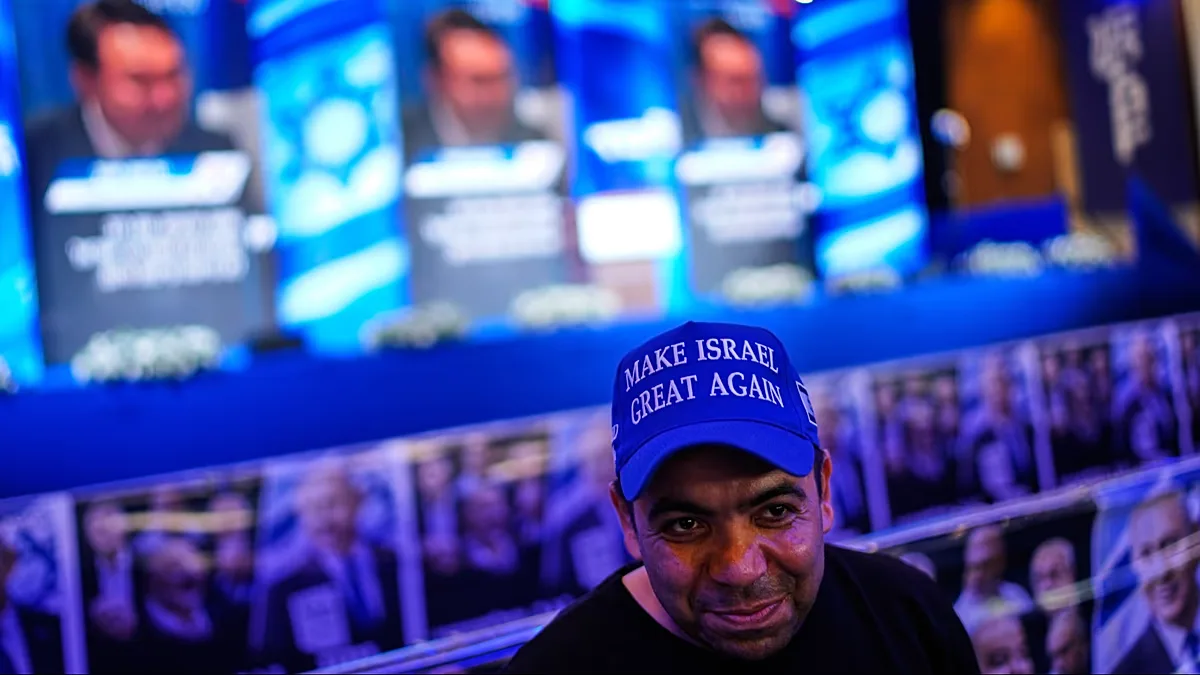
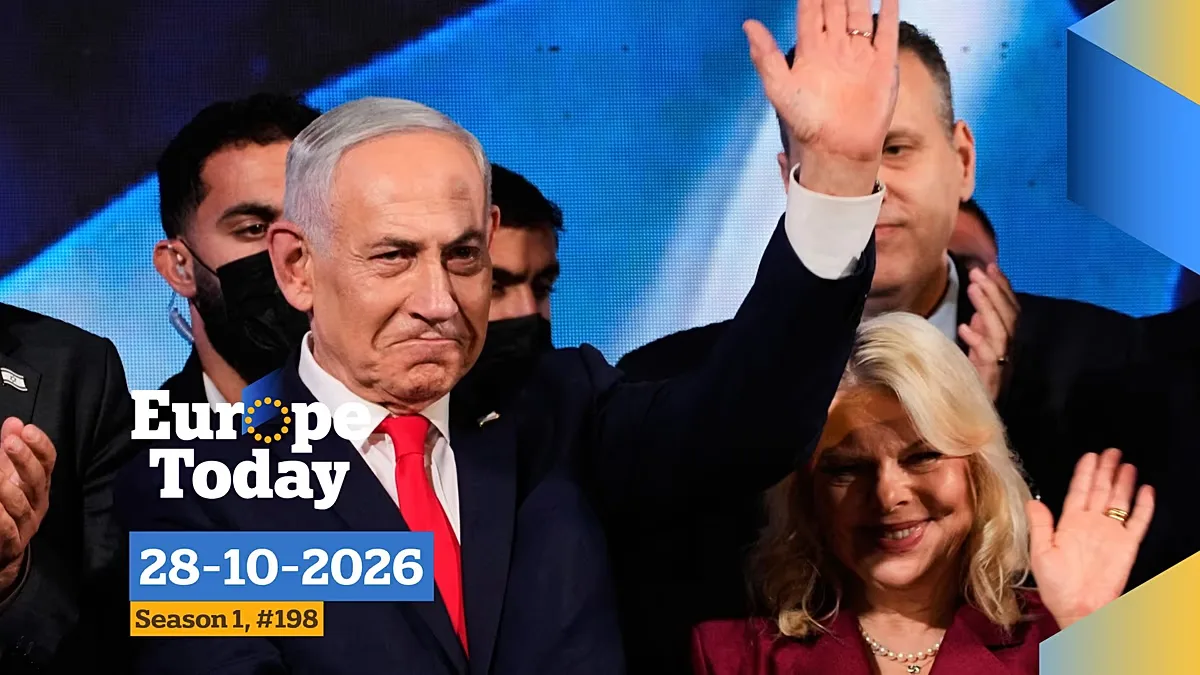
Elections in Israel: Key legislative elections in Israel show incumbent Israeli Prime Minister Benjamin Netanyahu standing ahead of the opposition Wednesday morning after 50% of votes have been counted. This is according to figures from the Central Elections Committee. Netanyahu's bloc is projected to win 56 of the 120 seats in the parliament, compared with 49 for the opposition bloc and 15 for the Arab parties.
Eylon Levy, former Israeli government spokesperson, just said on Europe Today that there are three options facing the political elite: form a unity government, form a minority government, or fresh elections. "All of those are going to require someone to surrender on some very serious coalition promises." Watch.
What is likely to come next is weeks of wrangling among parties to form a governing coalition and declare a new prime minister. In the meantime, Netanyahu remains as interim caretaker head of the government.
What is clear is that the country remains deeply divided over Netanyahu's leadership and remains damaged by the Hamas-led 7 October attacks and the wars that have since shaken the Middle East.
Phone a friend: The leaders of Finland and Norway spoke with Russian President Vladimir Putin on the phone for 90-minutes on Tuesday to restart the peace process. According to statements, the two leaders urged Putin to end the full-scale invasion and engage in meaningful negotiations to reach a stable, peaceful settlement.
As my colleague Jorge Liboreiro reports, that chat was followed by a phone call with Ukrainian President Volodymyr Zelenskyy, who thanked the duo for their "active" support and called for de-escalatory steps. (More analysis of the play-by-play below).
What is important to highlight now is that the Stubb-Støre move comes as the European Commission and the European Council prepare a joint team of senior officials to be sent to the next round of talks.
As Sasha Vakulina writes, Russia, Ukraine and the US could meet in Abu Dhabi on 4 November for talks. That's according to an announcement by Polish Prime Minister Donald Tusk on Tuesday.
According to Tusk, the provisional date emerged as European leaders coordinated diplomatic efforts with Kyiv and Washington ahead of possible negotiations. What's interesting is that this is occurring one day after the US midterm elections scheduled for Tuesday 3 November.
The timing raises questions about what comes next for Washington's efforts to end Moscow's war.
For those uninitiated: The midterms matter because they occur in the middle of a president's four-year term and determine the composition of the two chambers of Congress: the Senate and the House of Representatives.
The vote not only offers an opportunity for citizens to elect lawmakers — Republican or Democrat, for example — but also serves as a temperature check on a president's term in office. For US President Donald Trump, this is a mandate pockmarked by trade wars, hostility towards Ukraine, and a retreat from the transatlantic security architecture. Can the damage from the last 24-months be undone at the ballot box?
Keith Brannum, Truman National Security Project fellow and strategist, just told Europe Today that this Congress has been "subservient" to Trump. Democrats, however, have been "very vocal" about holding the president to account. "We are in uncertain times," he said, with no clear projection of the future. Watch.
Brussels news: Polish ambassador Agnieszka Bartol will depart Brussels to take a cabinet position at Tusk's government in Warsaw. She will remain his sherpa, having built on years of experience where she cut a reputation of smooth operator and became a fan-favourite of journalists in the Belgian capital. Polish Andrzej Domański is poised to become the country's next deputy prime minister.
More Brussels news: EU energy and defence commissioners Dan Jørgensen and Andrius Kubilius will today hold talks on energy security at the Berlaymont, bringing together stakeholders including NATO officials and industry heavyweights.
According to a leaked agenda obtained by my colleague Marta Pacheco, discussions will focus on EU fuel production for defence, particularly jet fuel output and logistics to meet a "potential demand surge".
Caspar Hobhouse, a research analyst at the EU Institute for Security Studies, said Europe's militaries primarily rely on two fuel sources: jet fuel for aviation and diesel to serve as backup power for military bases. "In the case of a military conflict, the demand is enormous," he told me.
'Very, very short business': Securing these fuel supplies is becoming more difficult due to the war in Iran and the closure of the Strait of Hormuz. Without major replenishments, Europe's current fuel reserves would leave it "very, very short business" in the event of armed aggression, Caspar said.
MEP Riho Terras, and former commander of the Estonian Defence Forces, welcomed the talks, warning that aggression is imminent and stressing the need for proper planning. "We have to be prepared," he said, including for plan Bs. "In 2007 I served in Iraq, then the whole country experienced a very big shortage of energy, and we dealt a lot with diesel generators there. In times of war, you need to have backups," Riho enthused.
Cash investment: A NATO spokesperson said it is "vital" that Europe's fuel production capacity can support both civil and military demands, particularly during crises and conflicts. In July, allies approved a €27 billion NATO Fuel Supply Chain Capability Programme Plan, which includes pipelines along the alliance's eastern and south-eastern corridors to ensure supplies for "warfighting readiness".
So what will come out of the talks? Monitor Euronews for updates.
Life after Vučić: After 14-years of Serbian Progressive Party (SNS) rule, the status quo was shattered on Monday when election results rolled in and foretold a new era for the Western Balkan country. This is one predominantly without former president Aleksandar Vučić, a free press and a reset of EU relations.
In the days since the seismic election, onlookers have witnessed scenes unfold on social media, of the lead anchor from national broadcaster Radio Television of Vojvodina (RTV) apologising to viewers for the last decade of alleged one-sided reporting.
On Tuesday, European Council President António Costa even called Ilija Srdanović, the leader of the Student List political movement, to say that parliament and government is expected to be formed swiftly. On top of this, most importantly, he communicated that "Serbia's place is in the European Union."
Marko Prelec, Balkans expert at the International Crisis Group, just told Europe Today that the new political elite "clearly seek" better relations with Europe and the EU itself. But how this will actually materialise is yet to be seen. Watch.
As the EU attempts to find the right tenor when speaking with China to eradicate an eye-watering trade deficit, it seems that a French football star has irritated officials in Beijing.
Mao migraine: Top French footballer Kylian Mbappé has lost several of his biggest sponsorship deals in China after a video circulated online in which he appears to joke about Mao Zedong, the founder of the People's Republic of China, that led to a backlash that he has now apologised for.
"My comment was ill-judged, and I now understand that it hurt many people in China and in Chinese communities around the world," Mbappé said in a statement he published in French, Chinese and English on Tuesday. "I apologise to everyone that my words have upset."
Ken Early, Irish football commentator, just told Europe Today that this is not the first time a political controversy has disrupted the activities on the pitch. "The German player Mesut Özil who played for Arsenal at the time, in 2019, posted on social media about the plight of the Uyghur people in China," he said.
"In that instance, they said, 'Okay, Arsenal won't be on Chinese television anymore." Watch.
After months dithering, Europe shows it's ready for talks with Russia
After months of bickering, Europe is sending its strongest signals yet that it is ready to speak directly with Russia to end the full-scale invasion of Ukraine and decide the future of the continent's security architecture.
Finnish President Alexander Stubb and Norwegian Prime Minister Jonas Gahr Støre marched ahead and held a phone call with Russian President Vladimir Putin to discuss the imminent restart of the peace process.
Though Stubb and Støre lacked a mandate to speak on behalf of Europe — they did so as “leaders of their respective countries” — their overture on Tuesday immediately positioned the Nordic duo as preeminent interlocutors. In its read-out, the Kremlin said that the three had "agreed to maintain direct telephone contact in the future".
The Stubb-Støre surprise move comes as the European Commission and the European Council prepare a joint team of senior officials to be sent to the next round of talks, scheduled to be held in Abu Dhabi in early November.
Is it notable that Brussels is openly stating its intention to hold the negotiations in a multilateral format, which would mean having Europeans, Ukrainians, Americans and Russians at the same table and at the same time. It is even more notable that Russia, rather than rejecting European presence, is now actively seeking it.
In his latest analysis, Jorge explains why Europe is more ready than ever to expand its diplomatic role and make its voice heard vis-a-vis Russia.
More from our newsrooms
Von der Leyen’s Canada ‘associate membership’ spurs battle of words with EU capitals. Last month, European Commission President Ursula von der Leyen made a bombshell offer to Canada: to become the first EU “associate member”. Now the term is proving hard to swallow for several member states, including her own Germany. Luca Bertuzzi has the must-read information.
Norway says 'successful' cyberattacks against the country have tripled in last six months. The country's National Security Authority said the rapid growth of artificial intelligence technology also posed a "serious risk" to Norwegian businesses and organisations. Read more of this story by Nathan Rennolds.
European disease control centre sends experts to Nigeria while Ebola cases surpass 10,000 in Congo. With the Ebola outbreak continuing to spread beyond the epicentre in the Democratic Republic of Congo — where it surpassed 10,000 cases — ECDC sent a team led by its senior expert in epidemic intelligence to Nigeria, the fourth African country to report an Ebola case. Giedre Peseckyte has the details.
We’re also keeping an eye on
Members of the European Parliament’s committee centred on civil liberties and justice will deliver a press conference in Hungary following a fact-finding mission.
European Commissioner for the Environment Jessika Roswall will be in Yerevan, Armenia for the UN Biodiversity Conference (COP17). She will deliver a press conference at 2:30 pm CET.
European Parliament President Roberta Metsola continues her visit to Malta.
European Commissioner for Justice Michael McGrath speaks at the meeting of the Freeze and Seize Taskforce.
That’s it for today. Jorge Liboreiro and Sasha Vakulina contributed to this newsletter.
Comments 0
No comments yet. Start the conversation.
Leave a comment