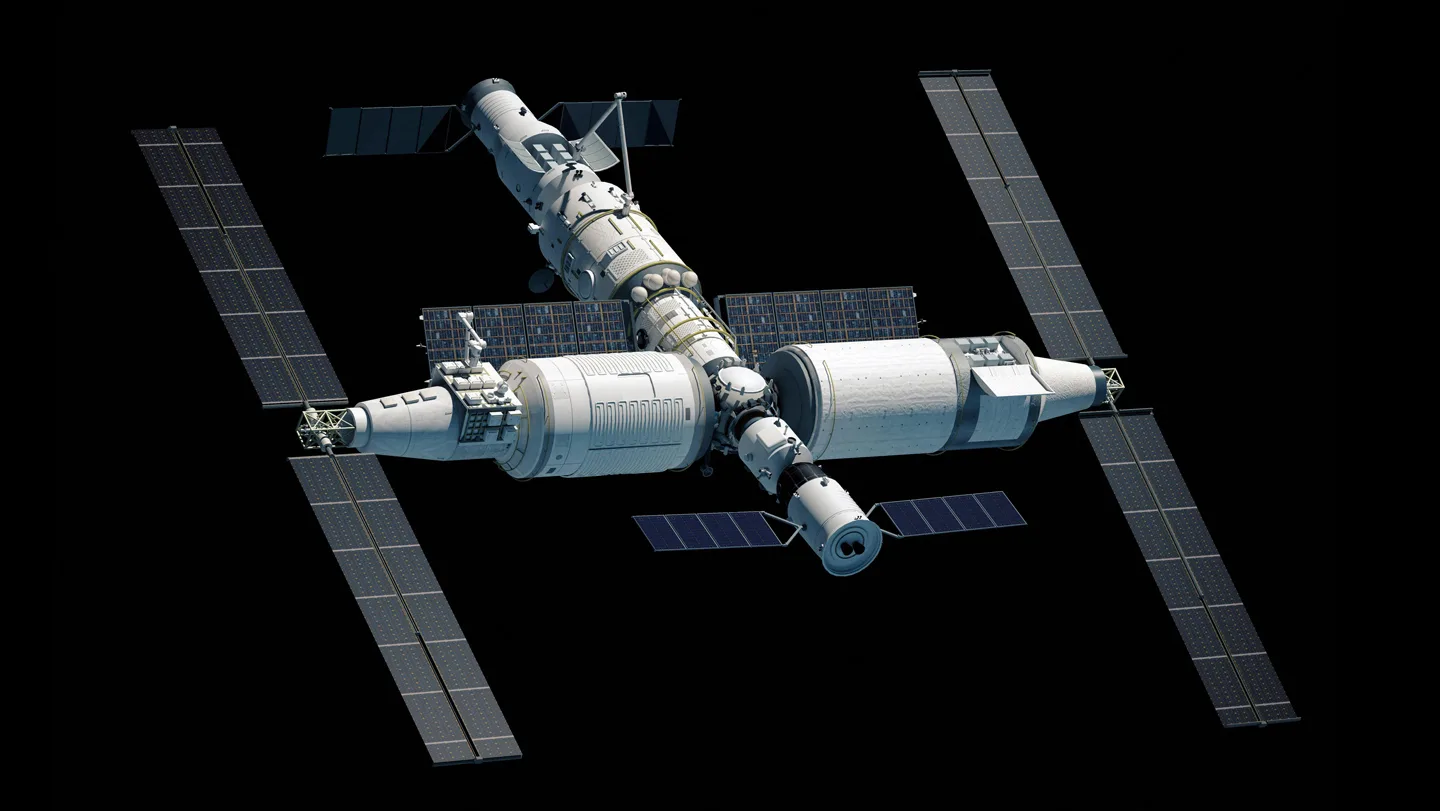
An experiment made famous by Galileo has been miniaturized to the atomic scale and sent into space.
To demonstrate that objects of different masses fall at the same rate, the 17th century Italian scientist is said — perhaps apocryphally — to have dropped weights from the Leaning Tower of Pisa. Now scientists have re-created that experiment with atoms falling while orbiting Earth. Two clouds of atoms aboard China’s Tiangong space station fell with nearly identical accelerations, researchers report August 28 in Science Advances.
The researchers measured the relative accelerations of two clouds of cold rubidium atoms. The atoms in each cloud had different masses because of a difference in the number of neutrons in their nuclei. Yet the accelerations of the two clouds matched to a precision of 0.05 thousandths of a percent.
The matching accelerations confirm that two different ways of defining mass are equivalent. One, gravitational mass, determines how an object responds to gravity’s pull. Another, inertial mass, determines how much an object accelerates when a given force pushes it. If the two definitions are equivalent, mass cancels out in the equations, and objects of different masses fall at the same rate in a vacuum. This concept, the weak equivalence principle, is a foundation of Albert Einstein’s general theory of relativity, which describes gravity as the warping of spacetime.
Scientists have tested the weak equivalence principle by dropping objects on Earth, including atoms. But objects on Earth can fall only so far, limiting the precision of such tests. In orbit, free fall can continue indefinitely. Space-based tests of falling metal cylinders on a satellite had previously confirmed the weak equivalence principle. Atoms, however, unlike larger objects, obey quantum physics, and it is worth checking whether they behave differently. Atoms in orbit take the weak equivalence principle to a whole new level.



Comments 0
No comments yet. Start the conversation.
Leave a comment