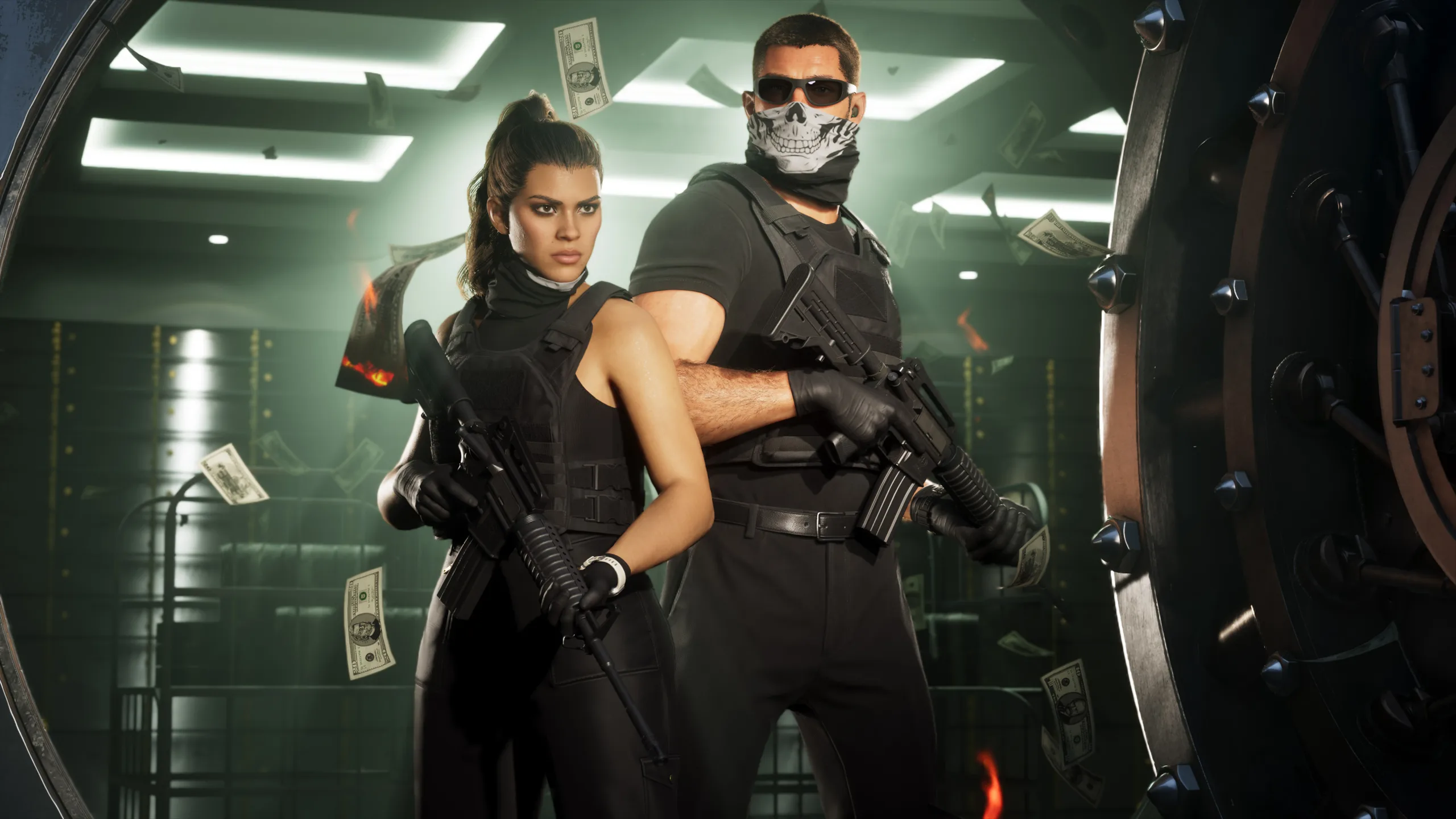
Just as much of its appeal comes from smaller, more personal moments: interacting with a dog, choosing a drink from the refrigerator, or holding your partner’s hand. These details suggest a game that wants ordinary life to feel as engaging as its criminal adventures.
The result is an intriguing picture of Rockstar’s next open world—one that combines familiar Grand Theft Auto chaos with more contextual interaction, a closely connected pair of protagonists, and action that repeatedly brings Max Payne to mind. Some moments point to specific mechanics, while others leave room for interpretation. That distinction matters, because several of the most exciting possibilities are still just that: possibilities.
A Familiar Job, a More Interactive World
The opening follows Jason and Lucia as they approach a residential complex to meet a drug dealer. It is a classic GTA setup, but the way the characters engage with their surroundings immediately gives the sequence a different feel.
The interaction system described here resembles the one in Red Dead Redemption 2. Holding L2 focuses attention on a person and brings up contextual options. Rather than treating everyone nearby as background scenery, the game appears to encourage more deliberate engagement with the people around you.
That approach extends to animals. When Jason approaches a dog, the available options include scolding it, petting it, and pressing R1 to study it. What “studying” an animal actually does remains unclear, but the interaction itself suggests that attention to the surrounding world will have a place alongside the larger missions.
As the pair move through the building, the camera transitions smoothly between over-the-shoulder gameplay and cinematic scenes. Predictably, the meeting falls apart, and the first shootout begins. Characters press against walls and fire from cover, while one particularly aggressive moment shows a person being thrown through a wall.
That last detail raises an obvious question: how much of the environment can players actually destroy? A dramatic scene does not necessarily establish a broader destruction system, so the extent of that interaction remains unknown. The sequence eventually takes Jason and Lucia through a densely furnished apartment before Lucia breaks a window and the two escape outside.
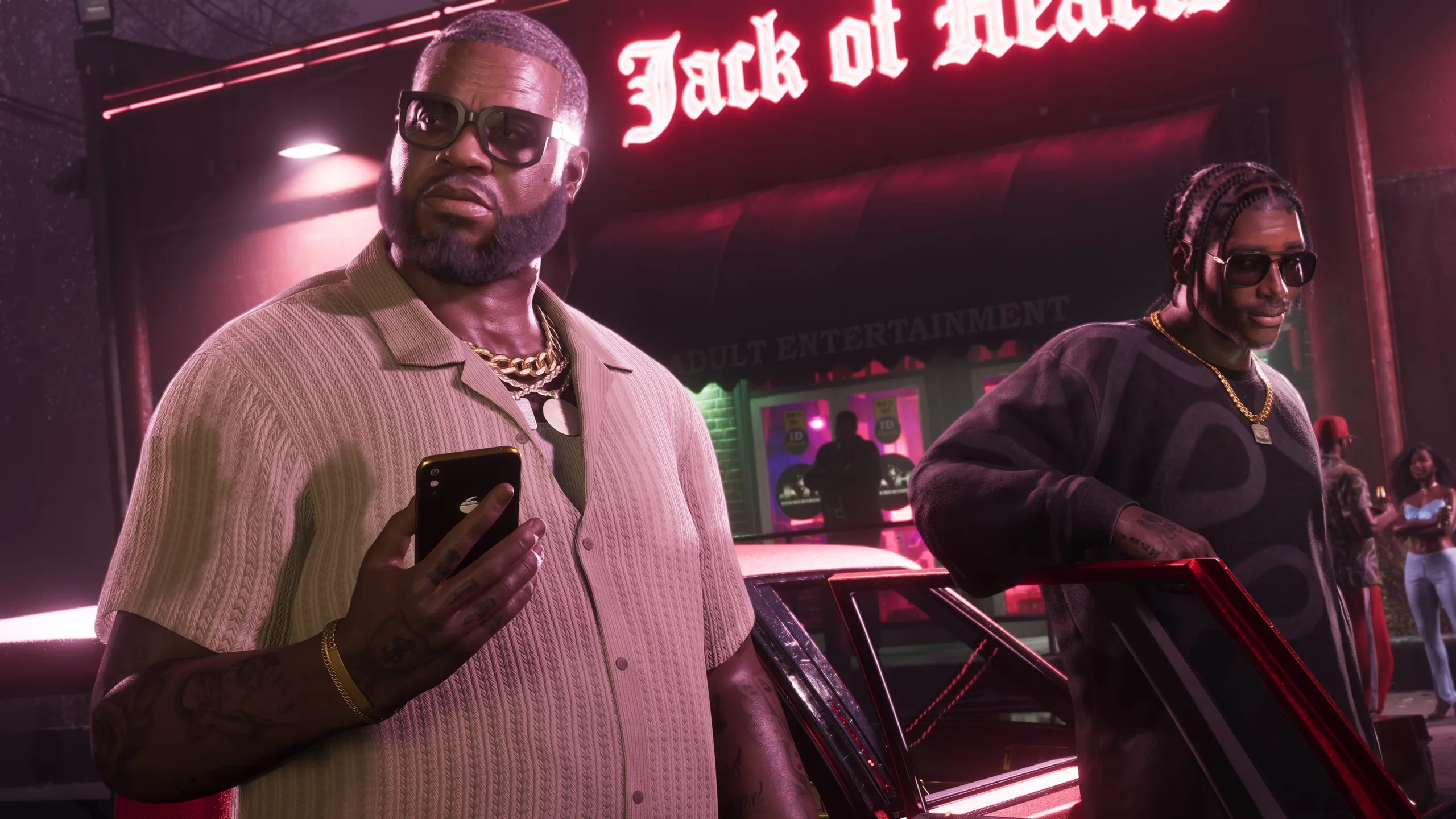
Combat with a Max Payne Edge
The gunplay is one of the commentary’s strongest points of enthusiasm. Its basic structure sounds familiar to anyone who has played GTA 5: move between cover, aim, fire, and pick up weapons dropped by enemies. But the presentation appears to lean into something more forceful and cinematic.
Slow-motion kills and sharply staged bursts of violence invite comparisons with Max Payne 3. The appeal is not simply that the action looks more detailed. It is that individual shots and movements seem to receive more attention, making a shootout feel like a carefully choreographed action sequence rather than just another exchange of gunfire.
There is also a potentially interesting moment involving cooperation between the protagonists. Jason asks Lucia to cover him, and she responds by stepping out and shooting. That could indicate some form of companion-command mechanic, but it could equally be a scripted part of the mission. For now, it is a reason to be curious about how the partnership works—not proof of a tactical command system.
Lucia’s close-combat sequence raises similar questions. Her movements look practiced and controlled, prompting the suggestion that she may be particularly capable in hand-to-hand fights. Counterattacks are another possibility, although the material does not establish how extensive the melee system will be. Alongside Jason’s slide across a car hood and Lucia’s one-handed shotgun stance, these moments give the action a strong sense of character.
A later shootout adds another intriguing detail: the ability to aim at different parts of an enemy during slow motion, including their weapon, potentially disarming them rather than simply going for a headshot. That is the kind of option that could make combat more expressive without abandoning the series’ straightforward action-game appeal.
Stealing Cars—and Managing What You Carry
Car theft remains firmly at the center of the experience. The commentary describes different ways to enter a vehicle, including using a specialized opening tool or simply smashing the window. Even in a series built around stealing cars, having distinct approaches adds texture to an action players will perform repeatedly.
The interface is just as interesting. Alongside the familiar weapon wheel, there appears to be a separate item wheel containing equipment such as body armor and what look like healing items or tonics. The display also distinguishes between money held in a bank account and cash carried in a wallet.
None of those details, on their own, tells us how demanding the inventory or economy will be. Their significance lies in the distinction they introduce between carrying a weapon, preparing useful supplies, and managing money. The question is how often those choices will matter once players are outside a carefully presented mission.
Jason and Lucia Have a Life Beyond the Next Robbery
Some of the most appealing scenes take place in the couple’s modest Vice City apartment. It is packed with small objects and everyday interactions: switching off lights, turning on the television, watching deliberately exaggerated advertising, and opening the refrigerator.
Inside that refrigerator, Jason can choose between different beers and a smoothie. The interface displays green and purple modifiers, which the commentary interprets as possible energy and focus-related bonuses. Those meanings are not established, but the scene suggests that food and drink may offer different temporary benefits. Elsewhere, Jason is described eating purchased food to restore his health.
The relationship between Jason and Lucia appears to extend beyond their work as criminal partners. The supplied commentary, citing gaming-press coverage, says players may be able to develop their romance through shared activities, affectionate interactions, and date-like outings. It also says they remain partners even without pursuing that romantic side.
What makes that idea compelling is the possibility of expressing the relationship through ordinary play. A button prompt to hold hands is a small interaction, but it gives the player a way to participate in a quiet moment rather than merely watching it happen. Jason holding a door open for Lucia serves a similar purpose: it makes the two characters feel aware of each other outside dialogue and combat.
Those details could help the partnership feel continuous. Jason and Lucia would not simply become a couple when a cutscene starts and return to being separate gameplay functions when it ends.
Vice City’s Appeal Is in Its Density
When the pair leave the apartment and drive through the city, the focus shifts to the amount of activity around them. The commentary describes heavy traffic, busy sidewalks, construction work, and people waiting at bus stops.
That density matters because a convincing city needs more than attractive buildings. It needs the impression that people have somewhere to go, something to do, and lives that continue beyond the player’s immediate attention.
The source also attributes a substantial size claim to GameSpot: a world approximately twice as large as Los Santos in GTA 5. That figure should be treated as a claim reported by the commentary, rather than an independently established measurement here. More important to the author’s impressions is how much activity appears to occupy that space.
The same emphasis carries into the beach scenes, where crowds remain prominent, and into views of the city from high above. The commentary’s excitement comes from the combination of scale and detail—not merely a beautiful close-up or an impressive skyline in isolation. Nighttime scenes add another layer through their lighting and camera work, reinforcing the sense of a city built to support cinematic moments without losing its broader scope.
Police Chases May Be About More Than Wanted Stars
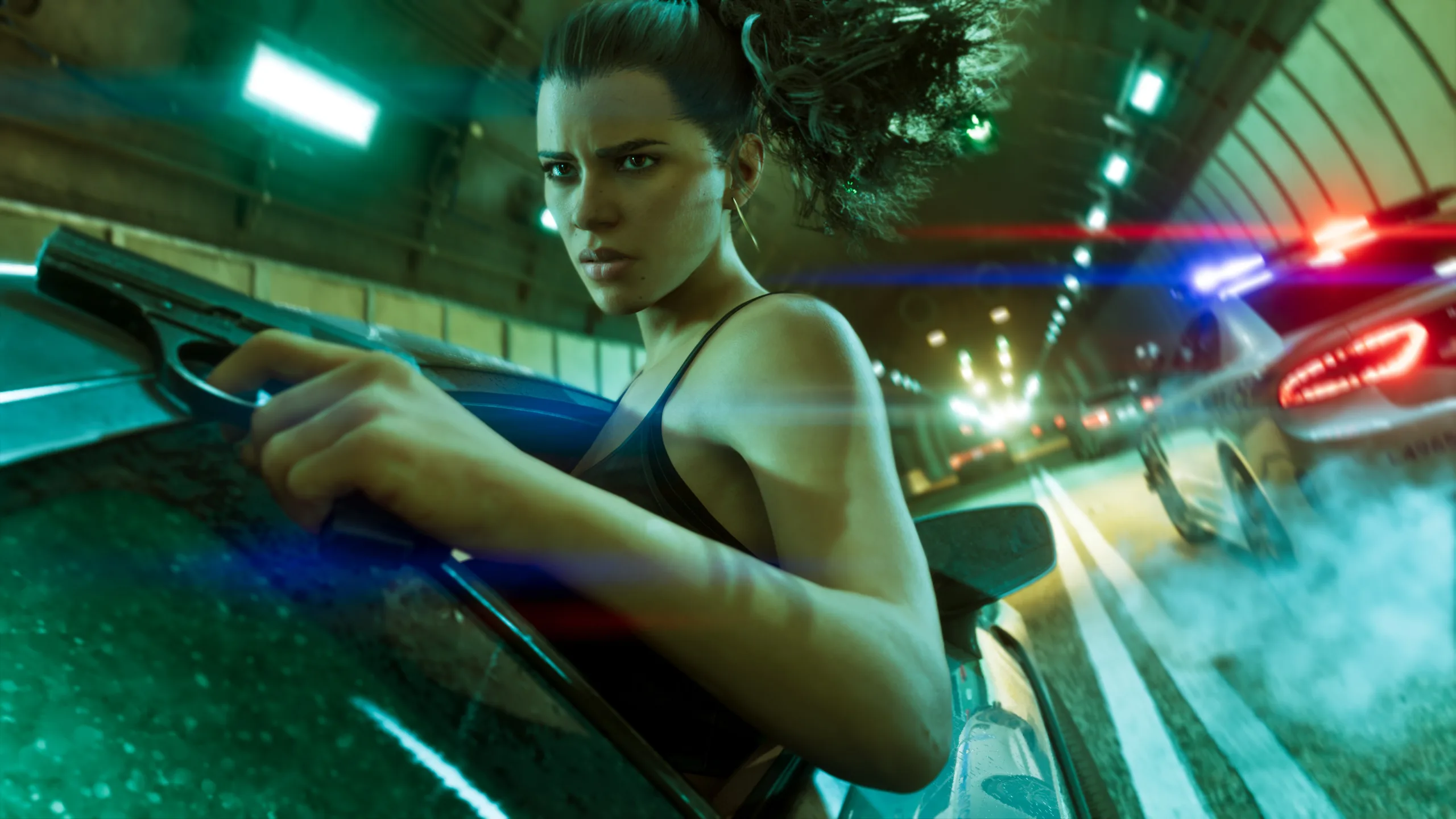
One of the most intriguing sequences involves Jason and Lucia escaping a police pursuit by burning their vehicle and switching to a van. As they abandon the original car, a vehicle-related icon disappears from the interface.
The commentary interprets this as part of a system that tracks what the police know about the suspects. Small icons may represent identifying information such as the vehicle, appearance, the number of people involved, or surveillance footage. A later scene is interpreted as indicating that the police have recognized the car, a character’s face, and their clothing. These remain interpretations of the interface, rather than a complete explanation of the system.
The possibility is exciting because it suggests a more specific kind of pursuit. Instead of thinking only about how far away the nearest police car is, players might also need to consider which identifying details still connect them to the crime.
The commentary also identifies what it describes as six wanted-star slots, with four active during one sequence, and takes that as evidence of a returning six-star wanted level. It is a striking observation, although it does not explain what the highest level would involve.
There Is Plenty to Do Between Missions
The activities described in the showcase range from basketball and scuba diving to exercise, street racing, and backyard wrestling. These quieter—or simply stranger—diversions help establish what life in the world might look like when the player is not following the main story.
The workout sequence is especially interesting because it apparently includes button prompts requiring alternating trigger inputs. That makes it look like an interactive activity rather than a background animation.
What exercise actually changes is still uncertain. The commentary raises the possibility of a fitness system and asks whether it could go as far as San Andreas-style changes to muscle or body weight. It does not establish that those visible transformations are present.
Character switching is another important part of the picture. Jason and Lucia can reportedly be swapped while traveling in the same vehicle, including during a police shootout, as well as when they are apart. That suggests the two-protagonist structure is not confined to separate missions: it can also shape how players experience the same situation from different roles.
A Crime Story with Room to Breathe
Between the action sequences, the commentary describes conversations that give the story a more reflective side. During a rooftop meeting with Brian and his wife, Lori, Brian advises Jason about knowing when to step away from a life of crime.
That idea offers a possible thematic thread: not just how far Jason and Lucia can go, but whether they will recognize the moment when they should stop. The surrounding footage moves between social encounters, robberies, and increasingly dangerous police confrontations, giving that advice an obvious tension.
Music helps shape the tone as well. The commentary mentions licensed tracks including “Let Your Love Flow” and “People Are People,” while describing the original score as lively, synth-driven, and influenced by the 1980s. Its impression is not of a relentlessly grim crime drama, but of something energetic and often playful despite the violence.
The closing action sequence brings those cinematic ambitions back into focus. Jason escorts people through a building before the situation erupts into gunfire, again drawing comparisons with Max Payne 3. The commentary emphasizes the staging of the quieter moments as much as the eventual shootout. Its excitement comes from the sense that gameplay, performance, and camera work are supporting the same scene.
The reported closing caption reads “Recorded on PlayStation 5,” without a Pro label. The source interprets that omission as indicating footage from a standard PS5; that hardware conclusion is an inference in the commentary, not an independently verified detail.
The Small Details Could Make the Biggest Difference
What stays with me most about this breakdown is not any single shootout, skyline, or chase. It is the possibility that the smaller systems will make those larger moments more meaningful.
An interactive apartment gives Jason and Lucia somewhere to return to. Shared activities give their relationship space outside the main plot. A police interface that communicates identifying information could turn an escape into something more thoughtful than simply driving faster. Contextual interactions could make the people and animals around the player feel less like scenery.
There are still important unanswered questions about how deep these systems go and how much of the described presentation reflects freely available gameplay rather than scripted sequences. But the vision outlined here is compelling: a GTA that is not only bigger and more cinematic, but more attentive to what happens between the explosions.
That is the version of Vice City I am most interested in exploring.
Enjoyed this article? Subscribe to my blog for more GTA 6 breakdowns, gameplay analysis, and a closer look at the details that make open worlds worth exploring.
Comments 0
No comments yet. Add a thoughtful first response.
Log in to comment